Practice, not theory
Nobody adopts anything off a deck. Adoption happens when someone runs the thing on their own data and sees what comes back. That is the consulting model the founders walked away from, and it shaped the product.

 The AI business platform
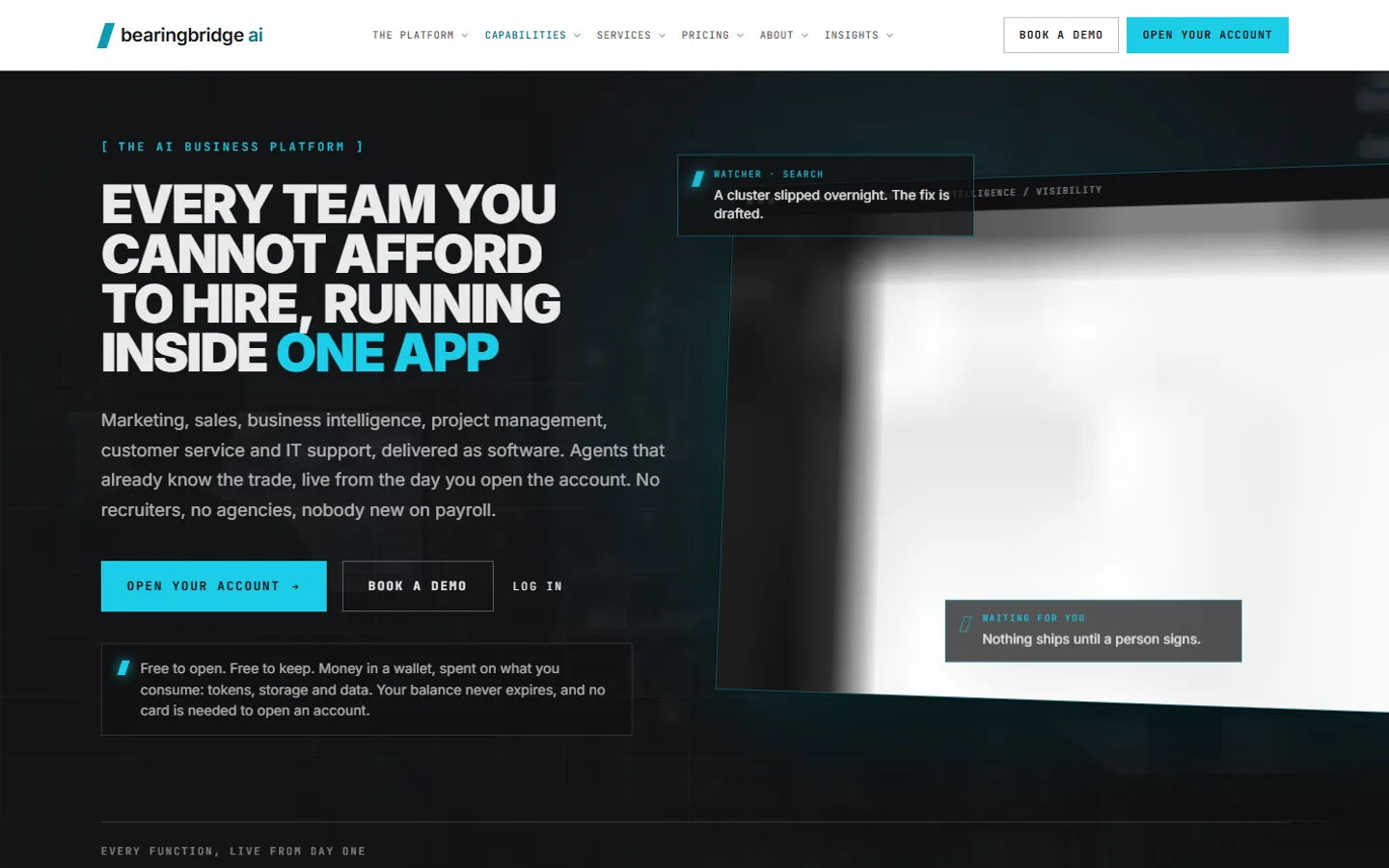
Marketing, sales, business intelligence, project management, customer service and IT support, delivered as software. The agents already know the trade, and they are live the day you open the account. No recruiters, no agency retainers, nobody new on payroll.
Free to open, free to keep. You put money in a wallet and spend it on what you consume: tokens, storage, data. The balance never expires, and no card is needed to open an account.
What a company could reach for was always capped by who it could afford to put on payroll. The competitor down the road was rarely smarter. Just staffed. That cap is the thing that moved, and BearingBridge was built on the assumption that it moved for good.
Nobody adopts anything off a deck. Adoption happens when someone runs the thing on their own data and sees what comes back. That is the consulting model the founders walked away from, and it shaped the product.
A twelve-person firm can run an analyst, a content team and a support desk without posting a single job. The work gets done at the size the company already is.
Most vendors bolt AI onto software they already sold you. Here the intelligence is the product, and it gets judged on what the output is worth against what the run cost.
Two you talk to directly, and two that decide how everything else behaves.
Ask a business question in plain words. It answers from your own data, quotes the real figure with its source, or tells you the data is not there.
Open Ask Intelligence ↗Chat with the models your administrator allows, three side by side, with the price sitting under every answer.
Open Playground ↗Watchers notice, drafters produce, and nothing ships until a person signs. Every agent carries a job, a schedule, a budget and a scope of data it may read.
Open Agents ↗How a brief gets built, how a campaign is structured, what a decent article actually looks like. The craft of the people who built the product, shipped as the default. You adjust it.
Open Skills ↗The same intelligence, the same agents and the same skills, pointed at the jobs a company has to get done anyway. Start with the one keeping you up. A module you have not switched on costs nothing.
Ask the business a question and get the real number with its source attached. Plus a Monday briefing on what moved, and why it moved.
A pipeline that drafts its own quotes, pins the next step on every deal, and flags the ones that have gone quiet.
Thirty-seven text formats, an article workspace that runs from brief to branded PDF, and a Creative Studio where images and video are priced before you press run.
Your rank by keyword, market and language, the terms competitors own and you do not, and what ChatGPT, Claude, Gemini and Perplexity say when somebody asks about you.
A calendar you sign off on, and drafts for LinkedIn, X, Instagram and TikTok checked against the real limits of each network before you ever read them.
Six steps from a keyword idea to a whole Google Ads campaign. One push builds it in your account, paused, with a watcher left running on it.
The board where findings turn into work, so an insight does not quietly die inside a report nobody opens.
Every text, image and video the product makes lands here with its prompt and its price. Name a folder in a brief and the AI writes from it.
Send an asset to a colleague for a decision. A card lands on their board, mail goes both ways, and no version is ever deleted.
A public assistant on your own page. It answers only from what you gave it, says so plainly when it does not know, and runs under a daily budget.
No tiers to decode, no per-seat arithmetic, no annual lock-in. Money sits in a wallet and gets spent on tokens, storage and data, and you see the price before anything spends it.
Give an account to everyone who needs one. The number on the invoice does not move when you do. Roles are still enforced.
Every run is quoted against your wallet before or as it runs, and itemised in the ledger afterwards. The machine’s own retries are not billed to you.
A hard cap per module, an approval gate in front of anything that publishes or spends, and a zero balance that simply stops the AI.
Nothing ships until a person signs. That sentence is the product.
For most companies the standard product ends the conversation. If it does not end yours, dedicated hosting puts the whole thing on a single tenant in the region you name, with backups that stay there and an uptime number written into the contract. Same product, your own instance, provisioned in about two weeks.
Read security and data ↗Software on its own connects to nothing. A guided session gets your brands, markets and budget caps configured, the systems you already run get plugged in and reconciled, and the team is trained by role rather than by feature. After that you can keep a named operator on the account, or run it yourself. Most do the second one.
See all services ↗An azimuth is the angle between north and where you are heading. Navigators take one before they move and check it as they go, because feeling on course and being on course are different facts. Six legs, a gate between each. You move on when the evidence has earned it.
Baseline, metric, kill criterion. All three agreed in writing before anyone builds a thing, so that six months later nobody has to argue about what success was supposed to mean.
We had an agency for search, another for content and a freelancer for the ads. Now Search tells us what dog owners are actually asking, the content comes out in our voice, and the campaigns arrive built and priced. Two of us run it from one screen. We let the agency go in the spring and only finance noticed.
Ninety minutes gets your brands, markets and budget caps configured. Five days later you are running it yourself. Bring your brand materials and your market scope. Leave the prompt library at home, the agents come configured for their trade.